George Brown design students showcase thesis work, at annual Year End Show.
From quantum computing to chocolate factory histories, the Year End Show (YES) highlights the depth and diversity of the School of Design
The second floor of the Daniel’s Building buzzed with energy to close out April, as graduating students unveiled their thesis projects at YES, the annual event for all things design.
The exhibition brought together students from across the School of Design, including Graphic Design, Brand Design, among others; drawing crowds to see what a year of hard work looks like up close.
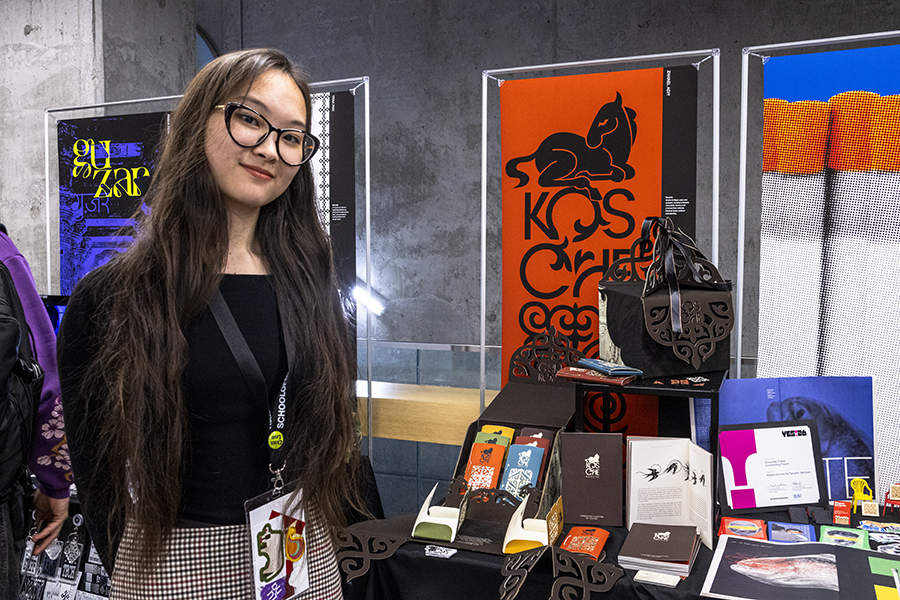
Zhanel Adiy, a graphic design student, centred her thesis on something deeply personal. Her branding concept for Kosche is built around a real chocolate factory that operated in Kazakhstan in the 19th century, the first of its kind in the country, before colonization forced it to close.
“There’s no representation of Kazakhstan. It’s not a well-known country, it’s really easy to manipulate with information,” said Adiy.
Her project was about more than branding. It was about correcting a narrative. Her work pushes back against stereotypes reinforced by films like Borat through visual and philosophical storytelling.
Gaya Khiani, a digital experience design student, set out to make one of the most complex topics in modern technology feel approachable to everyone. Her project is a fully non-technical explainer on quantum computing.
“With AI, a lot of what happened is that the people who sort of knew about it, like 10 years ago, were ahead of, like, we’re sort of ahead when it actually became mainstream,” said Khiani. “And I think that it’s really important that more people have access to it in the start, because it’s not about the technology, but it’s people have access to that technology.”
Getting there meant long nights spent working through dense academic research papers with no technical background to lean on. She came out the other side with a new appreciation for the subject.
“It made me honestly hate math a little less, because it was, like, absolutely interesting.”
The people behind YES were just as proud of what filled the room. Tony Allen, program coordinator for Interaction Design, described the show as a rare chance for students to practice explaining their work to real audiences while giving the public a window into what design students actually produce.
“It’s a chance for one student gets to practice speaking and pitching and explaining their process to industry folks or anyone that’s asking,” said Allen.
For Khiani, standing at her booth and talking through her work with strangers offered something a portfolio link never could.
“I think the most main component is like talking to people and getting to explain it to them and answer their questions, Because I think it’s one thing for me to just, like, put some like, put some LinkedIn and give people a link to the website, but it’s another thing when they can, like, read it in front of me and ask me questions, and I can answer them and prove that, like, I actually know what I’m doing.”
YES, runs annually at the end of the academic year and remains one of the School of Design’s most important traditions.
It’s a reminder that the best design work does not stay on a screen but finds its way into the hands and conversations of real people.