The unraveling of a “subtle little book”
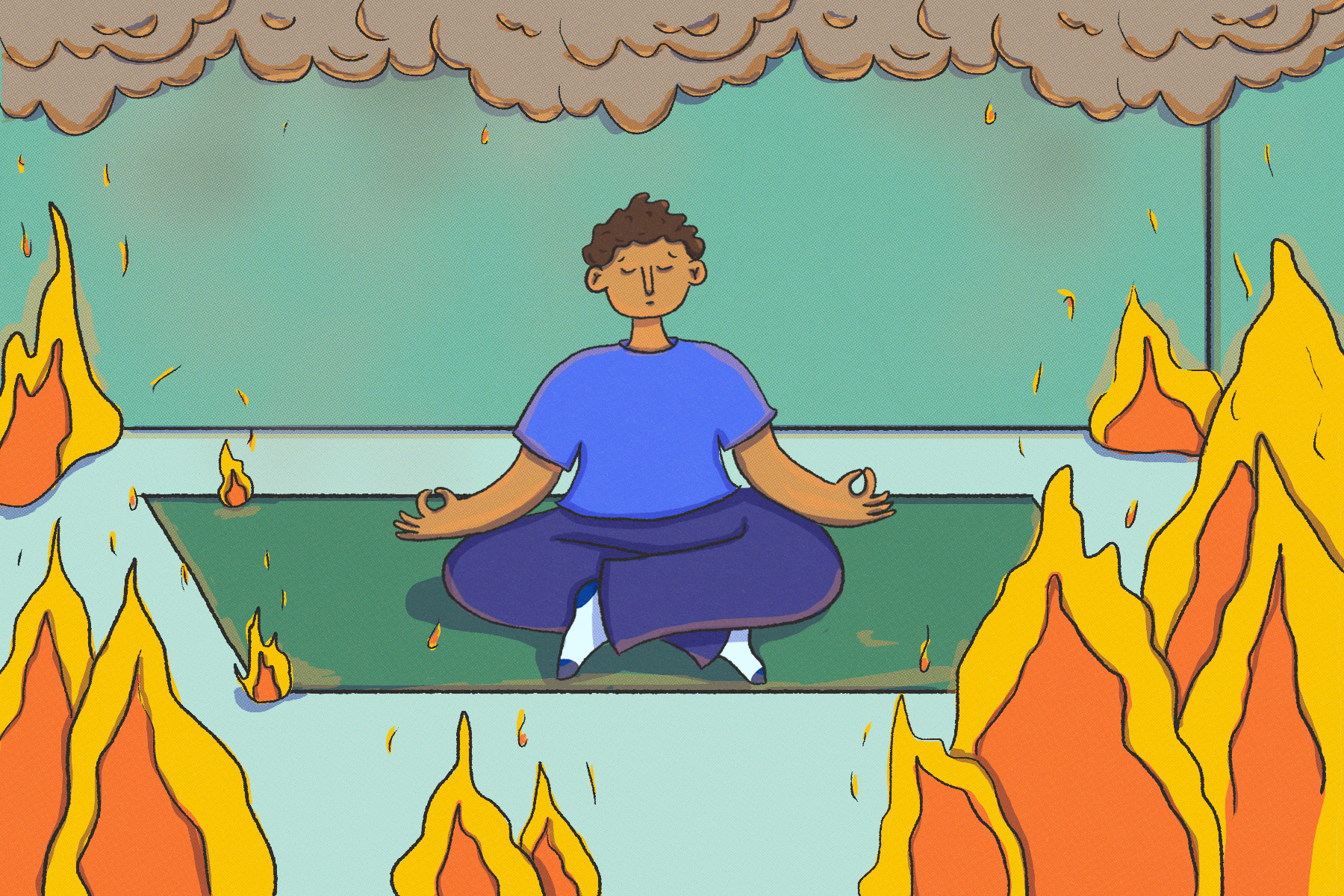
In the first pages of his book Yoga, Emmanuel Carrère mentions that he had planned to write “a light, subtle, and optimistic little book about yoga.”
The reader naturally assumes they know what this journey is about. After all, the book is called Yoga, right? Well, not exactly. Right away, Carrère shatters that expectation by stating, “the book you’re holding in your hands is not that book.” Without any hint of what is to come, the reader simply follows along.
In stark contrast to that initial calm and subtle idea, the story takes us on a chaotic journey. In fact, it’s one so marked by mental collapse and controversy, that the reader begins to question not only what is happening in the story – but also the narrator’s very character.
Although Carrère warns us this isn’t a book about yoga, he does begin with the practice at the heart of the story. The narrator heads off to a ten-day Vipassana meditation retreat in rural France.
With his keen attention and prior knowledge of the practice, he observes his fellow silent meditators and reflects on his long history with yoga and tai chi. He is brutally honest about the difficulties of the practice, admitting to having shown up to a session drunk and confessing that he used meditation less for enlightenment and more for gathering material for his book.
This self-awareness is part of his candid portrayal of the narrator’s mind.
He exposes his weaknesses without demanding that we identify with them, yet by revealing this vulnerable side, he captures our empathy or at least our curiosity. However, the retreat was violently interrupted by the attack on Charlie Hebdo in January 2015.
Carrère leaves to be with a friend and soon plunges into a deep depression that lands him in the hospital, where he undergoes electroconvulsive therapy.
It is in the second half that Yoga feels like a completely different book, shifting from a clear and serene autobiography into a kind of disorienting puzzle.
Carrère must navigate this enormous void at the center of his own story, which leads to some strange moments where he plays with the truth. He presents a story as pure autobiography, only to later admit that a key figure is “partially fictional.”
The reader is then left wondering whether they should trust this work at all, or what to expect from this so-called “autobiography.”

Some readers see this as a unique window into a mind in ruins, reflecting the chaos of its own making. The work has been described as a form of “self-cannibalism,” where the author lays everything bare, even the most intimate recesses of his soul. The work grapples with the paradox of a consciousness that is constantly observing itself.
On the other hand, this extreme vulnerability could also be seen as purely performative.
After all, throughout the book, the author himself questions whether we can trust him. Are these accounts even real? Is this truly an autobiography? It depends on how much the reader is willing to trust what is being said.
The book can also be read as a satire of intellectual pretension, or of the “mad genius” archetype so often associated with writers. Reading can become a grueling exercise in introspection, where the reader is trapped inside the “excessive self-awareness” of a narrator they simply cannot bring themselves to like or trust.
No matter which side the reader falls on, this is undeniably a book that exposes the pain, confusion, and delusions of someone suffering while analyzing themselves in real time recording their own pain as they experience it.
The entire path of the book is directly intertwined with a mind on the edge, in extreme collapse.
Ultimately, Yoga is not a book about the practice of yoga. It is a book about the impossibility of writing a book about yoga.
It is a testimony – perhaps a diary – of Carrère’s ability to render his psychological collapse deeply compelling yet laced with heavy doses of disbelief and moral ambiguity.
The book walks dangerously close to the edge of what is acceptable. It leaves us with an uncomfortable question: does the art that emerges from all this destruction justify the damage left in its wake?