
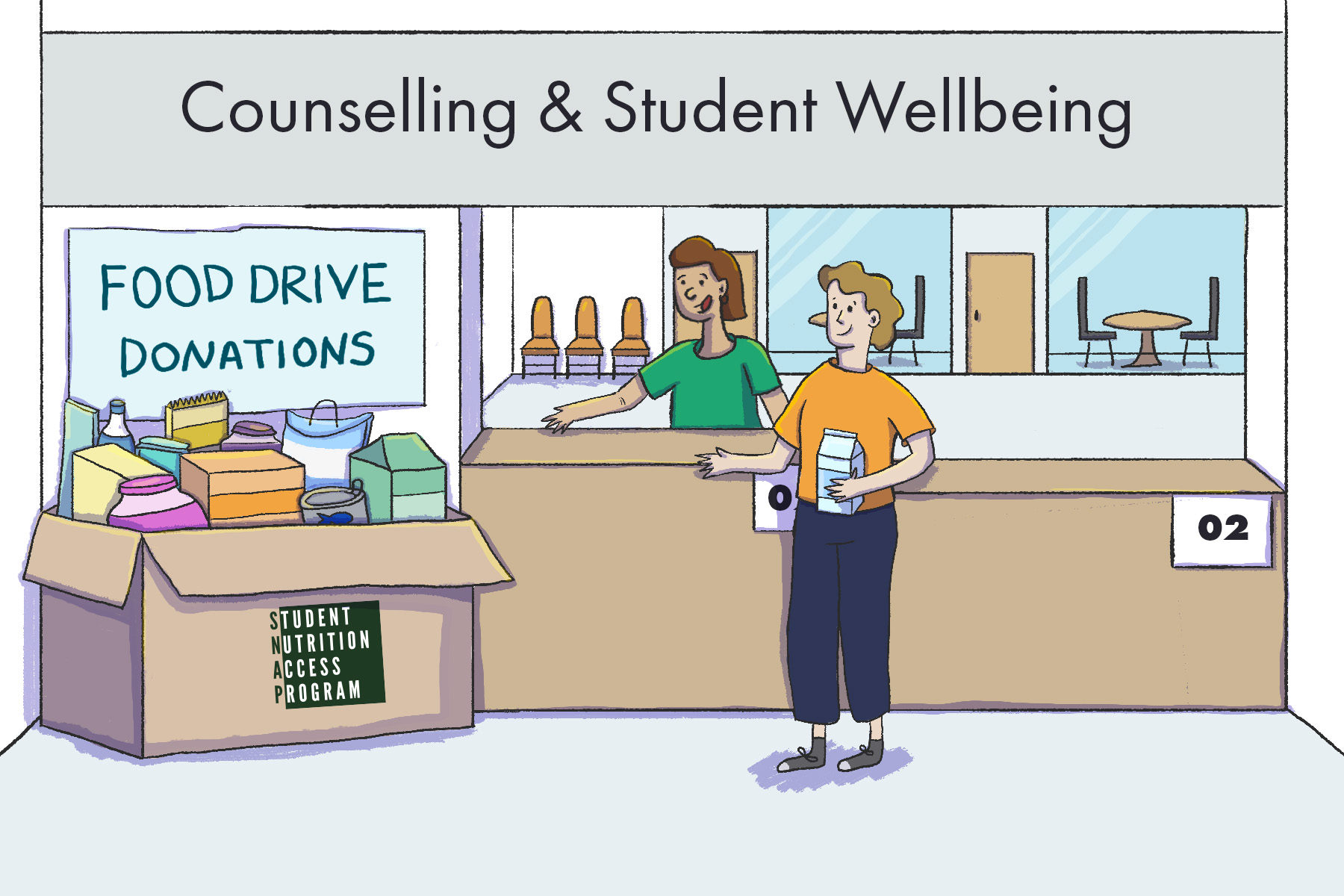
SNAP teams up with college department amid increase in food insecurity.
Help students experiencing food insecurity by donating to the ongoing food drive.
Running until Jan. 31, the drive was started by the Counselling and Student Well-Being department after they noticed students attending counselling sessions were experiencing increased food insecurity.
All donations collected will go directly to the Student Nutrition Access Program (SNAP) which will then be accessible to students who are registered for their pantry program.
“The partnership began when [the] Counselling and Student Well-Being department reached out to SNAP after noticing increased food insecurity amongst students attending counselling sessions – with some students disclosing they have not eaten for days. To provide immediate hunger relief for these students, SNAP has been preparing Nourish ‘n’ Go snack bags to be made available at the Counselling and Student Well-Being offices at St. James, Casa Loma, and Waterfront campuses throughout the week,” said Ruka Watanabe, coordinator with SNAP.
SNAP focuses on education and programming related to nutrition and how it can affect mental health and academics. One of the things the department offers is a food pantry which can be accessed by students experiencing food insecurity.
Of course, the issue of food insecurity is prevalent across the city of Toronto, with one in 10 people accessing food banks. In fact, since 2021, the number of people visiting food banks has gone up exponentially with users making more frequent visits and accessing them for longer periods.
North York Harvest Food Bank and Daily Bread Food Bank released the Who’s Hungry 2025 report, which states that between April 2024 and March 2025, there were more than 4.1-million food bank visits. This is an increase of 18 per cent over the previous year, with the number ballooning to an increase of 340 per cent from 2019 to 2025.
The report also notes that the number of kids experiencing food insecurity is on the rise, with 25 per cent of clients of food banks being minors. What’s more, 18 per cent of households with kids reported that their kids went hungry at least once a week over the course of the previous three months.
Financial stresses are noted as one of the biggest factors contributing to food insecurity among respondents in the report, as the majority of people – 53 per cent – noted that they skipped a meal to pay for something else.
“When financial resources are limited, food is often the first to be impacted with some choosing to skip meals, and others choosing highly processed and low-quality foods to reduce their expenses. At SNAP, we want to ensure that all students have an equitable opportunity to thrive academically and a well-stocked pantry with diverse food groups allows us to do that by providing students with access to nutritious food, while alleviating financial stress,” Watanabe added.
For those who are able to help by donating to the food drive items that would be most helpful for the pantry are:
- Dried & canned beans, peas, lentils.
- Canned fish.
- Shelf-stable milk alternatives.
- Peanut and alternative butters.
- Pasta sauce and pasta.
- Flour, noodles, and rice.
- Easy to prepare meals and meal kits (e.g., taco kit).
Items can be dropped off to the Counselling and Student Well-Being offices located at each of the three major campuses: St. James – Room 582C, Casa Loma – Room C317, Waterfront –Room 225.
As 2026 rolls along, Watanabe hopes that the community can come together during trying times, to help those in need.
“Each of us at George Brown College – students, staff, faculty, leadership – make up this larger campus community and it is essential to hold care for one another [and] demonstrate that through action. For those who have capacity, means, and resources, we hope they can gift hope to GBC’s student community by donating to the food drive. We hope this initiative not only spreads awareness about SNAP’s food support initiatives that are available for all current students to access, but also inspire everyone to contribute to spreading care and compassion beyond GBC as well.”