
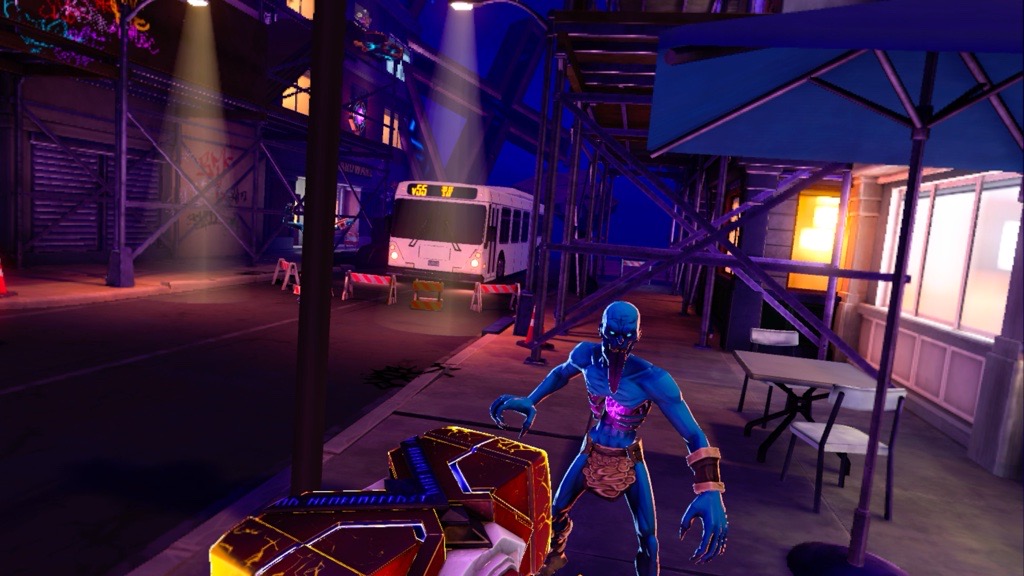
Interesting ideas can’t help this game from being just another tedious roguelite.
The nine realms are colliding, and Norse mythology has invaded New York City.
To push back the monsters of Scandinavian lore, the famed hammer Mjolnir has chosen you – someone who vandalizes the city with graffiti – to wield it and stop Ragnarök. To sorta paraphrase one of the many movies, in the franchise that has brought on as much fatigue as the roguelite genre: you are worthy, now you possess the power of Thor.
In Street Gods, by developer Soul Assembly (Last Stand), your journey is your own as you’ll use a Tafl board to plan your route across the city.
Now, a quick history lesson for those who don’t know – and there are probably many.
Tafl or Hnefatafl are a series of strategy board games played by those in northern Europe. Games were played in places like Norway, Sweden, Denmark, and Britain among others. While some versions of the game are still played depending on where you are in the world – or games considered to be in the Tafl family – Chess has essentially taken over the mantle of this Viking pastime.
Regardless of the etymology, Soul Assembly is mixing and mashing terms to make their game make sense.
We don’t want people starting to start using terms incorrectly because some virtual reality (VR) game made them think this was correct now, do we?
You’ll move around city streets and plan your ever-changing run, as you work towards stopping the trouble before you. This involves a ton of smashing, magic and teleporting around a bright but not so graphically encapsulating city.
Gameplay does not at all seem to include physics-based combat, instead opting for a more arcade style of wild physical movements. You’ll end up working up a sweat depending on how much effort you put into your playthrough; but if someone were to sit in a recliner and wiggle the controller to dispatch enemies, they’d probably find it a very relaxing and easy experience.
While this isn’t necessarily a problem for the casual gamer, if you were not a fan of Deadpool VR due to the very simplistic combat, then there’s a good chance that you’ll feel about the same here.
For the gamer who wants to feel a little more weight to their actions, Street Gods has none. Instead, you’re offered a lot of what you might expect from a game in the roguelite genre, except that there’s simply an empty feeling which seems to suck the interest out of a monotonous game.
Add onto that the grind that comes from this being a roguelite and you may find this just isn’t for you – at least until there’s a steep discount.
Starting off, you’re given a limited number of available movements; more will unlock as you progress through the game. Your ability to do well in the virtual world will also help you to unlock permanent upgrades, though if you played Hellsweeper VR, you’ll be met with a very similar laborious grind.
Regardless your ability to smash – and whatever verbs one might come up with for the handful of other weapons that become available – will help you to become better equipped to save the city.
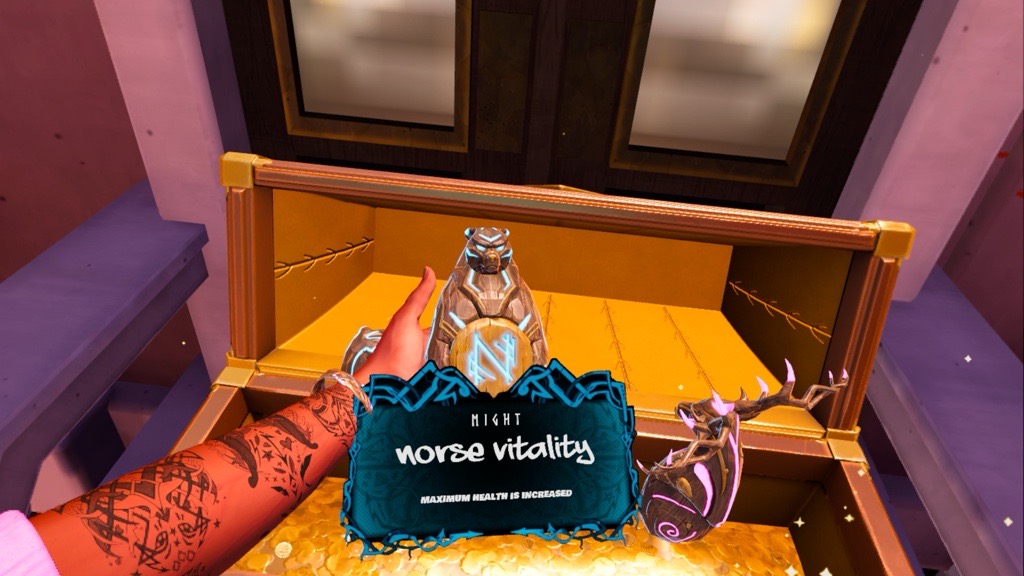
The game plays out essentially as one might expect a roguelite would, as you fight your way across levels that get more tedious with each run. Upgrades are found throughout your runs which give you buffs to stay the course: more health, defence, attack, etc., can be found from chests. Abilities such as new weapons are also found throughout – however you have to have a real interest in staying invested in this very pedantic game.
Now let’s talk mechanics.
You’ll smash, destroy and throw hammers with ease across the limited settings before you.
The usual suspects are configured as you would expect with the thumbsticks and grip buttons moving and grabbing. Though an oversight on the part of Soul Assembly shows a flaw where it seems like you can only grab your hammer with your right hand, this means you can only use your left to grab everything else. Trying to move Mjolnir between hands does not work, just as trying to grab pieces for the Tafl board route does not work with your right – anytime planning the route was attempted with the right hand the hammer would appear.
The triggers can activate different weapons/functions – left activates a whip, though it doesn’t always work on first attempt and the right works with your hammer’s abilities. Face buttons do different things once you have unlocked abilities such as dashing.
The problems with mechanics – besides the grip conundrum – are not an overtly complicated system, but a lack of basic things like controller haptics and any sense that there’s an impact to your actions. One might think that smashing in the face of a Norse zombie thing would garner at least a sense of feeling in the controllers, however, there’s less impact here than a duck fart in an open field.
This could be considered an oversight, but honestly this comes from the same team that’s had Last Stand in early access for more than a year and seemingly abandoned it in early 2025. It’s been a few months now since release and the game seems to have been abandoned, showing that there may not have been a want for something like his.
Graphically the game is alright, but things in headset certainly do not look as good as the promo materials make it out to be. The world has form, but textures just aren’t there, with your character – obviously the weapons – and the majority of the enemies have the most detail on them. There are instances where some of the bigger bosses – especially during bouts of high action – will look to be at a lower quality than the zombies enemies that you’ll dispatch throughout the majority of the game.
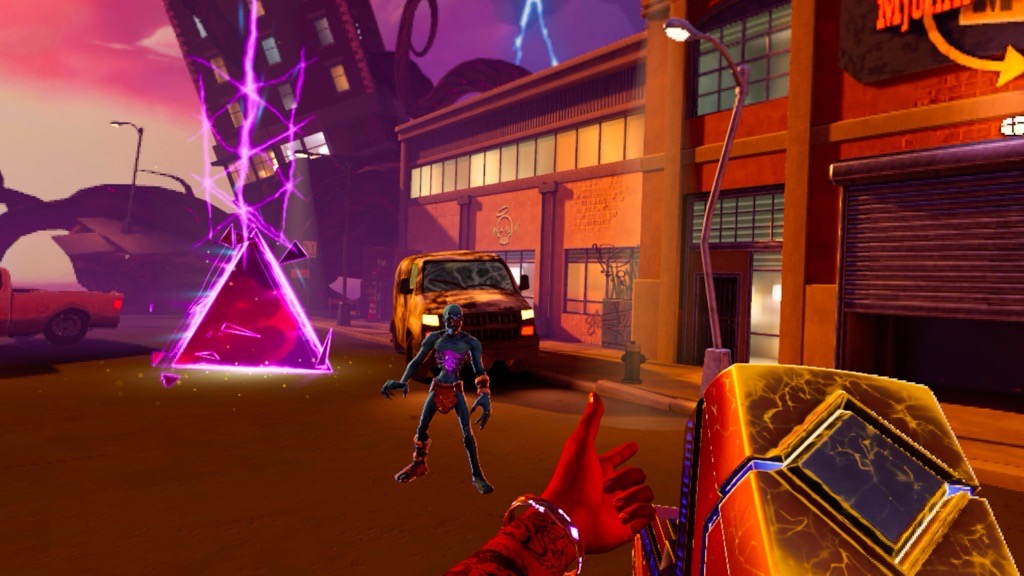
In case you’re counting, this is now the millionth game from Soul Assembly – kidding they don’t have that many published games – that seems to have zombies included.
Aren’t they the most innovative group of VR developers out there…
Putting aside the limited imagination of the development team, the graphics are not what you might expect – or depending on your experience with this group/ a Quest headset, it might be exactly what one would expect. The contradictions aside, up close things look ok. The game is being played on a Quest 3 so you can expect the game to be basic with lower quality textures and a framerate that can struggle, but the game actually avoids framerate issues – at least up close – by limiting the number of enemies on screen.
However, if your enemies are even remotely in the distance, their graphical quality is like night and day; that is to say, they’re much lower quality and there’s an ugliness to the framerate.
Oh, there’s a comic book quality to the world design, but it just doesn’t work here. Now this can be dependent on taste, but if you played the recent MIB: Most Wanted game, then you’ll know that not only is it possible to make a game with a comic book feel work, but it can thrive.
Here, it just falls flat.
Overall, Street Gods is a game that people will enjoy if lowbrow humour, Norse mythology, or zombies are your thing. However, if you’re looking for a quality roguelite you could look elsewhere and find something which will check off all the boxes a little bit better. The game can be fun in the right circumstances and the fanboy ability to use Mjolnir is something any Marvel fan will enjoy; but it may not be enough for those who are spending $34 of their hard-earned dollars.
Perhaps Soul Assembly just needs to try something new, because at this point Ragnarök might be seen as a blessing to forget this game exists.
Street Gods, was reviewed on the Quest 3 after receiving a review key from PressEngine.
2 thoughts on “VirtualRealities: Street Gods”
Comments are closed.