
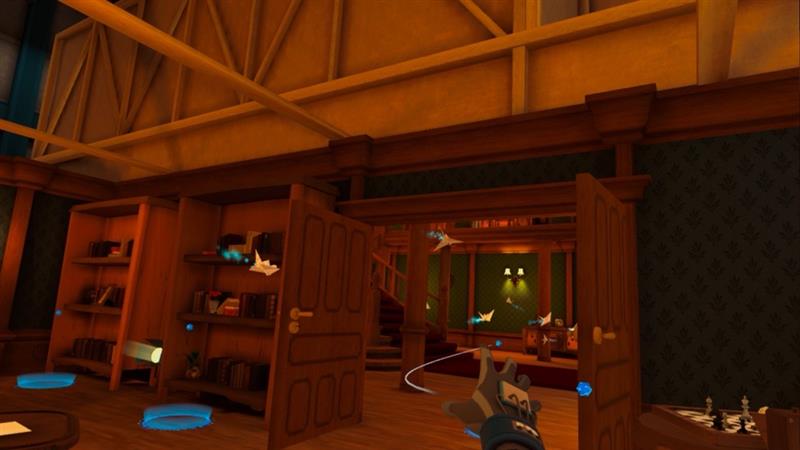
Engaging puzzles don’t help this game overcome messy hand tracking controls.
For as much you want this to be great, the controls on Cinescape just hold it back.
Oh, so how one might wish that this game by SUPER AC – released Dec. 12 – would be good. It’s not like it’s a game that just does everything bad.
The puzzles are intuitive and actually make players use their brains. There is no button for hints to make you glide through, instead, you have to wait for the random robot who follows you around to make a comment which relates to what’s currently holding you up.
Graphics are great and there are no real bugs. So why then is the game not being recommended?
Well, that’s simple… it’s because the developers force players to use hand-tracking for the title – which ends up causing more issues that necessary.
Cinescape is an escape room styled puzzle game which sets you – the player – as someone inheriting the mantle of a now defunct movie studio. You’ll travel across different setting – different movies – solving puzzles as you work to fix the issues each holds.
Let’s just get this out of the way before we continue. Hand-tracking is absolutely a step forward, especially with regards to virtual reality (VR). Properly implementing this technology works wonders as it can offer those looking to experience a game in a new way, something spectacular.
However, if one just forces the control scheme on the average user – solidly in the hand-tracking is great camp here – then it can end up detracting from the overall game.
In Cinescape you’ll find yourself moving between puzzles, in similar fashion to the great VR titles like The Room VR, or House of Da Vinci VR. While the idea is easy, simply point your fingers where you want to go and pinch them together, it seems impossibly tedious compared to the teleportation of the aforementioned games.
Now, locomotion controls are always simpler. The thumbsticks and face buttons enable players to perform actions quicker, and with an ease they just can’t get with the intuitiveness of hand-tracking.
Now don’t take the term surrounding “intuitive” to mean better. Just because it’s fun and engaging to grab, make motions, or in any way use your hands for a game, does not mean that it makes it simpler for the overall gaming experience.
While a game like Crumbling – which uses simplistic hang gestures over a diorama where you don’t have to move – is fun to play, it doesn’t mean that moving around a full space is easy. Games like A Rogue Escape end up being terrible because you have to balance shooting and moving in a teleportation format – fully controlled by your hands alone.
Since the game is based on solving puzzles, and the hand tracking means there’s not much beyond grabbing and using the items before you, the mechanics are out of the way. Although, this silly annoyance should be mentioned.
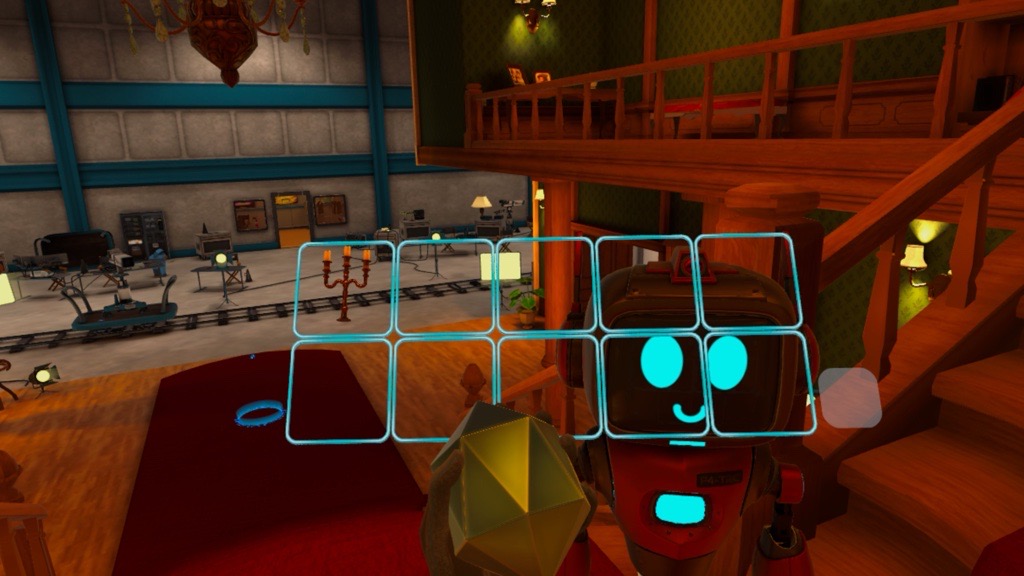
Opening your inventory means flipping over your left hand. Once you do this, the items stored will appear in a grid. While this is very simple, if you even open the inventory by accident, the grid stays open for basically the rest of your life. The only way to close it is to physically hit the button in the corner, which honestly seems like way too much effort.
Again, controls are not good and wholly detract from the experience.
Now, let’s discuss graphics, which are solid in the game.
Settings and characters look great – though the voice acting could use some work. Nothing is blurry, and everything looks like you’re in a high-quality cartoon-styled world.
There were no glitches or framerate issues experienced, so things were solid as a whole throughout the very minimal three levels.
Yes, you read that right, there’s only three levels – and very few puzzles included in each. Essentially, you’ll move between a few different spaces, solving between four to six puzzles per setting.
What sets this game apart from others is what’s called “cinemorphosis.” Basically, you’ll be able to turn movie props – you are jumping between movies sets after all “cine” is in the name, duh – into real objects, and vice versa.
While a different aspect compared to other games, this is actually quite pedantic as you’ll touch a wall to make a keypad appear, or turn a clock into cardboard so you can light it on fire.
Again, this is all done with your hand-tracking so nothing beyond touching stuff – no we’re not Donald Trump level perverts – is required to progress.
Beyond this, there’s nothing much to the game beyond finding your way to the end.
Overall Cinescape has a great look but offers little in terms of engagement from puzzles – and the hand-tracking can make you consistently want to pull your hair out, or more likely refund this $30 game.
What was considered a promising title by reviewers who accept monetary bribes, became a shadow dropped title that still doesn’t even appear on the Quest store without searching. It’s this that should make players wary about giving away their money to a developer who can’t even be showcased among the “new releases” section alongside garbage titles like Garten of Banban, Boom Karts and Street Gods.
There’s much better escape room titles out there – hopefully you haven’t played them all – and certainly better ways to spend your money. Good graphics aren’t enough to save a game that forces you into using a movement system that’s simply inferior, without offering an alternative.
Cinescape was reviewed on the Quest 3 after purchasing from the Quest store at full price.